
Growth Marketing Blog
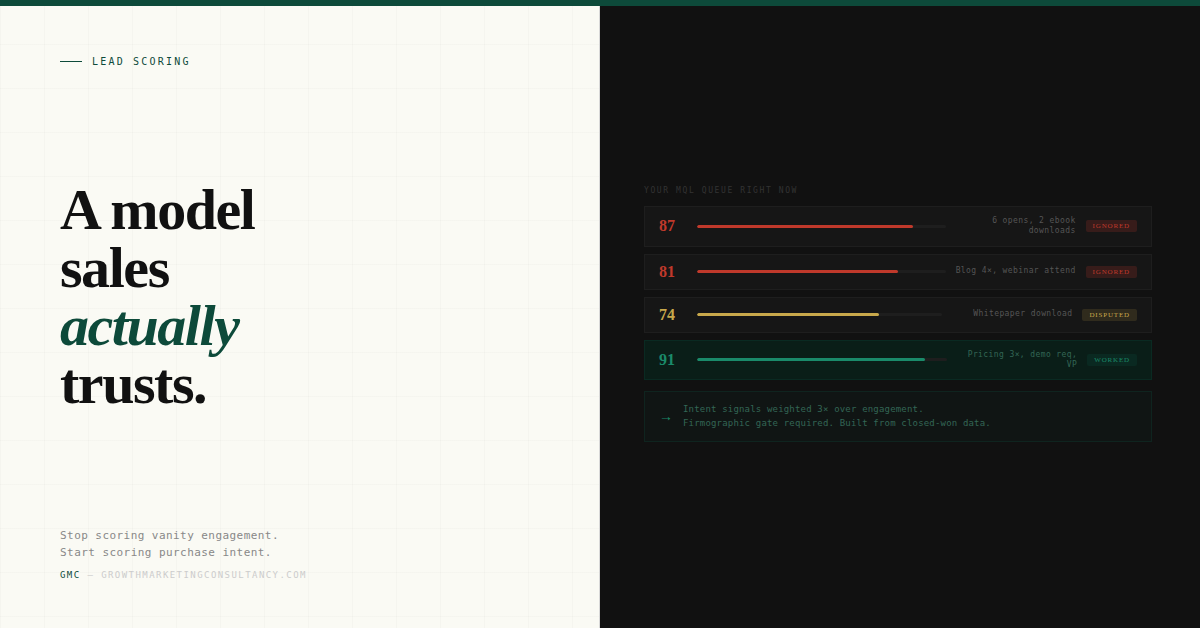
If your sales team has stopped working your MQL queue, the lead scoring model isn't a marketing problem. It's a trust problem. Here's how to fix it — starting from closed-won data, not assumptions.

Growth plateaus don't announce themselves. By the time they're visible in a board deck, they're already six months old. This is the diagnostic framework for spotting the six warning signals early — before the question gets asked in a room you weren't ready for.

There's a specific kind of silence in a PE board meeting when someone asks "what actually drove pipeline this quarter?" and no one has a clean answer. This is the five-part framework for turning messy data into a growth story you can defend in any room.

If your growth team is pulling numbers from six different tools and still can't answer the question "what actually drove pipeline this quarter?" — you don't have a data problem. You have a coherence problem. Here's the teardown.

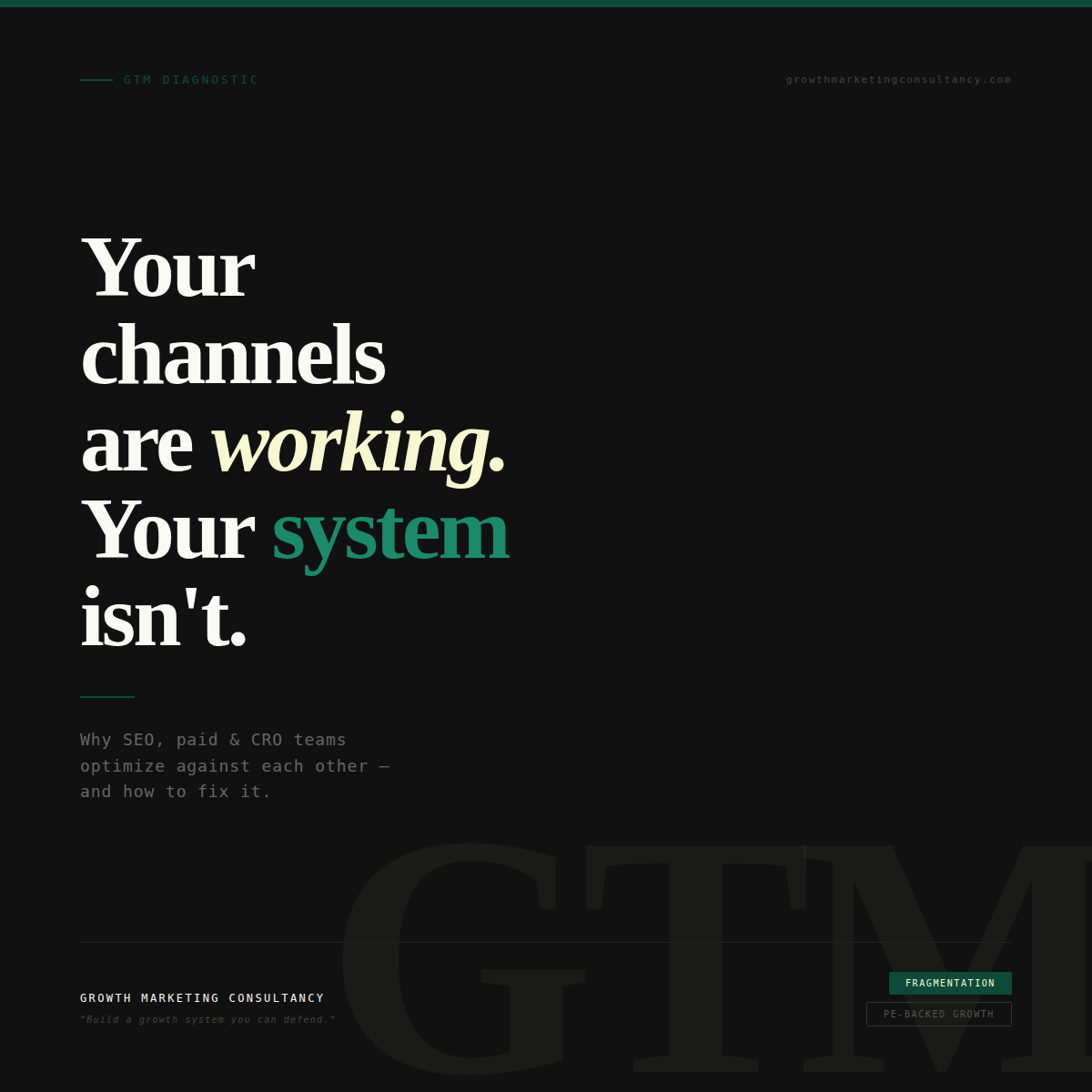
Growth plateaus. Pipeline gets inconsistent. Leadership starts asking questions. The diagnosis — delivered either internally or by a consultant — is that you need better SEO, or stronger paid, or a proper CRO programme. So you hire an agency to fix it.
Six months later, the channel they own is performing better. But pipeline still isn't where it needs to be. So you add another agency for the next weakest channel. Then another.
Before long you have four vendors, five dashboards, a weekly meeting with each of them, and a reporting process that takes your team three days to pull together every month. And when the PE sponsor asks what actually drove pipeline growth last quarter, nobody has a clean answer — because nobody owns the full picture.
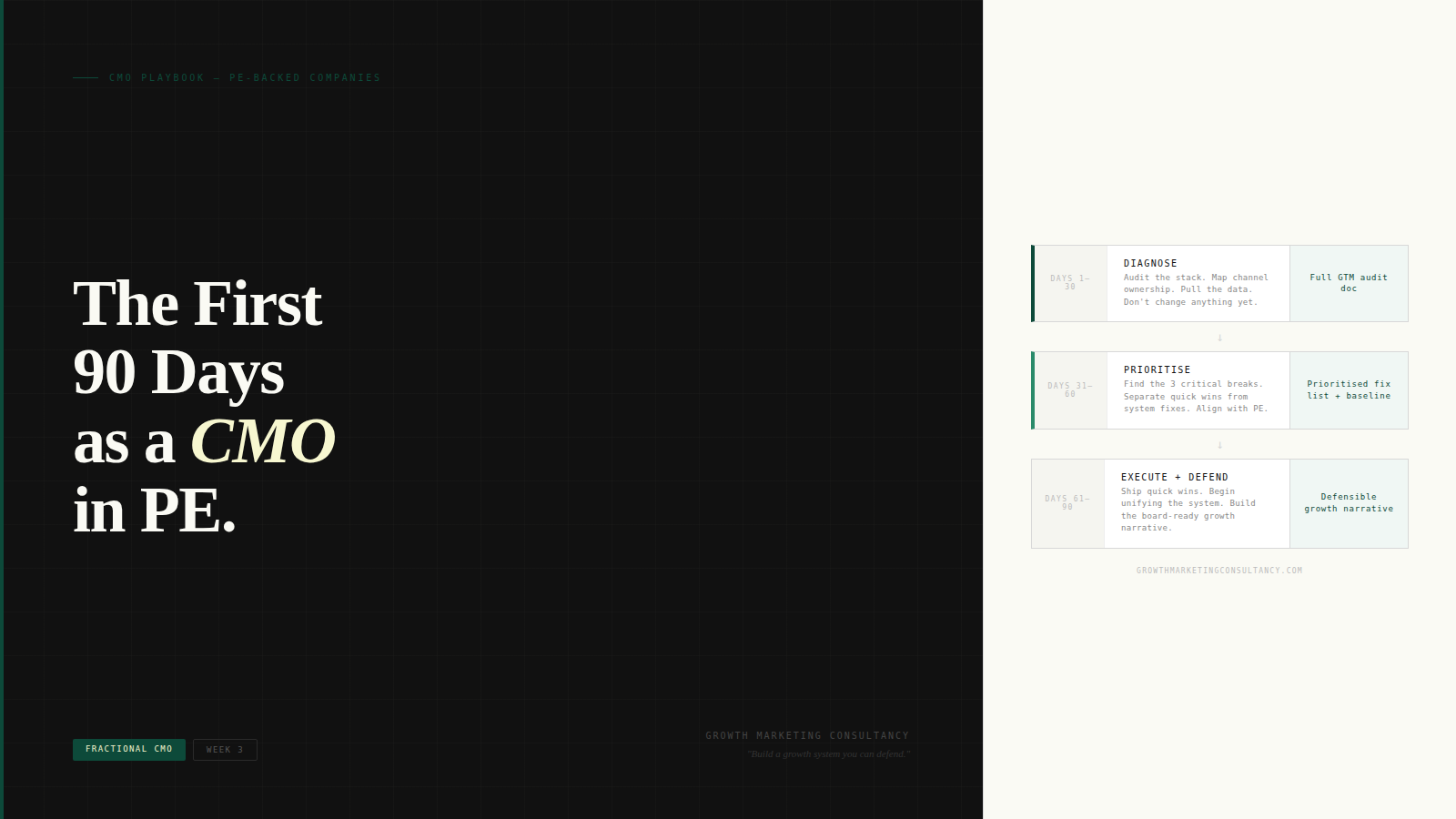
New CMOs in PE-backed companies don't fail because of bad strategy. They fail because they start fixing things before they understand what's actually broken.
Most inherit a fragmented system — disconnected channels, unreliable reporting, and a 90-day clock that nobody officially announces but everyone in the room is watching.
This is the diagnostic playbook that changes how you enter — and how you're perceived for the next 18 months.
Most teams treat SEO and paid search as separate playbooks — but the real growth happens when you align them. In this post, we break down why integrating organic and paid search strategies drives better results across traffic, conversions, and ROI — and how to build synergy between the two.
SEO isn’t just a traffic channel — it’s a foundational part of a scalable growth marketing system. In this post, we break down how SEO connects with paid media, CRO, lifecycle marketing, and demand generation to drive sustainable, full-funnel growth.
As AI-powered search and large language models reshape how users find answers, many marketers are wondering: does SEO still matter? The answer is a resounding yes — but your strategy needs to evolve. In this post, we explore why SEO is still critical for growth, how AI is shifting search behavior, and what to do to stay visible in the age of intelligent search.
Acquisition gets the headlines, but lifecycle marketing often delivers the ROI. In this post, we explore why retention, reactivation, and post-purchase engagement programs are the true growth drivers for high-performing brands — and how to build systems that scale revenue without constantly increasing acquisition spend.
Acquisition gets the attention — but retention drives the real growth. In this post, we share a practical customer retention playbook to help you keep buyers engaged after the first purchase, reduce churn, and increase lifetime value through smart lifecycle marketing systems.
Most PE-backed marketing teams are buying AI tools to fix a growth problem that isn't a technology problem. AI amplifies whatever system already exists — fragmented or not. Here's why the sequence matters, and what to fix before you automate anything.