
Why Your SEO, Paid, and CRO Teams Are All Optimizing Against Each Other (And How to Fix It)
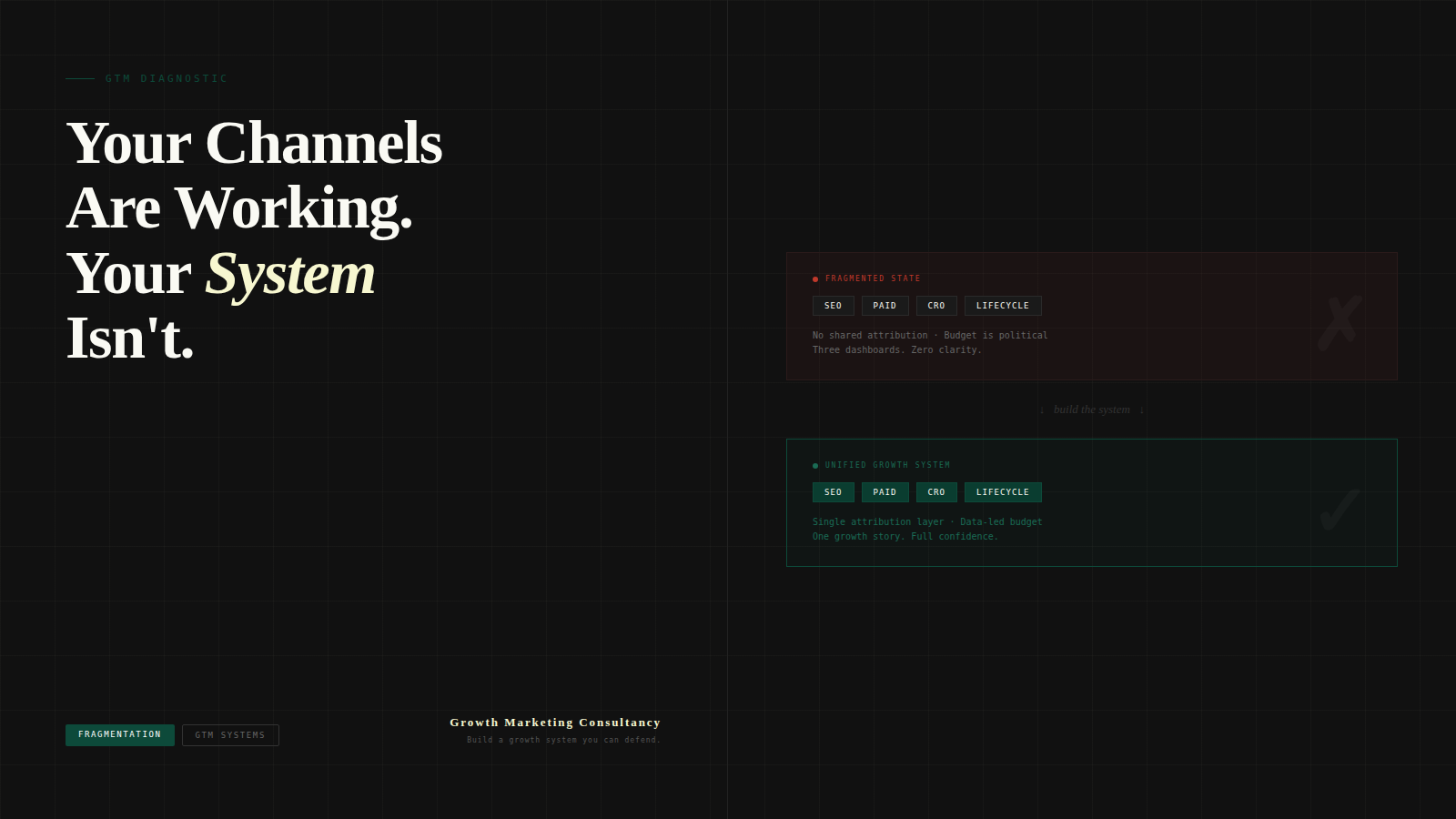
Most growth teams think they have a traffic problem. They actually have a coherence problem.
The Uncomfortable Diagnosis
If you're running SEO, paid media, and CRO as separate workstreams — each with their own owners, their own KPIs, and their own reporting — you don't have a growth system. You have three separate optimization loops that occasionally produce results in the same direction.
And here's what nobody says out loud: those loops often directly contradict each other.
Your SEO team is building topical authority for high-intent informational keywords. Your paid team is bidding on the same branded terms and cannibalizing organic clicks you were already getting for free. Your CRO team is running A/B tests on landing pages that your SEO team built around specific on-page structures — and winning variants are quietly destroying the page's ability to rank.
Nobody is doing anything wrong. Everyone is doing their job. The system is the problem.
The Three Fragmentation Patterns That Kill Mid-Market Growth
After working inside PE-backed companies and founder-led teams, the same three breakdowns appear with near-perfect consistency. They're not unique to any industry or company size. They're structural — and they're almost invisible until you're looking for them.
Pattern 1: The Attribution War
Your paid team reports on last-click conversions. Your SEO team reports on organic traffic and rankings. Your CRO team reports on conversion rate improvements. Each number looks good in isolation. None of them tell you what actually drove revenue.
When the PE sponsor asks "What moved pipeline this quarter?", everyone points to their own dashboard. The result is a meeting where three people are technically right and nobody has a useful answer.
The downstream effect is worse than awkward QBRs. When attribution is fragmented, budget decisions are political instead of analytical. The loudest channel wins. Not the most efficient one.
Pattern 2: The Keyword Cannibalization Loop
This one is quietly expensive. Your paid team is under pressure to hit volume targets, so they bid on branded and near-branded terms — terms your SEO work already owns. You're paying for clicks you earned.
At the same time, SEO is building content around high-funnel informational queries to build authority. Paid is ignoring that content entirely and sending cold traffic to bottom-funnel product pages. The warm leads that SEO is nurturing through content have no coordinated paid retargeting sequence. The hand-off doesn't exist.
Meanwhile, CRO is optimizing the bottom-funnel pages using testing tools that occasionally strip out the structured content and internal linking SEO needs to maintain rankings. A test wins on conversion rate. Two months later, organic traffic to that page drops 40%.
No single person made a bad decision. The system produced a bad outcome.
Pattern 3: The Lifecycle Gap
You're spending on acquisition. You're optimizing conversion. But the moment someone converts, the system forgets everything it knew about them.
What content did they read before converting? Which paid campaign sourced them? What objections did they raise in the CRO test variants? That information lives in four different tools, owned by three different teams, and none of it informs your email sequences, your retention strategy, or your expansion revenue efforts.
This is where LTV gets destroyed — quietly, after the conversion metric looks great.
What a Unified System Actually Looks Like
The fix isn't a new tool. It isn't a bigger team. It's a shared operating logic that connects every channel around a single question: what moves a qualified prospect from first touch to retained customer, and what is each channel's specific role in that journey?
Here's what that looks like in practice.
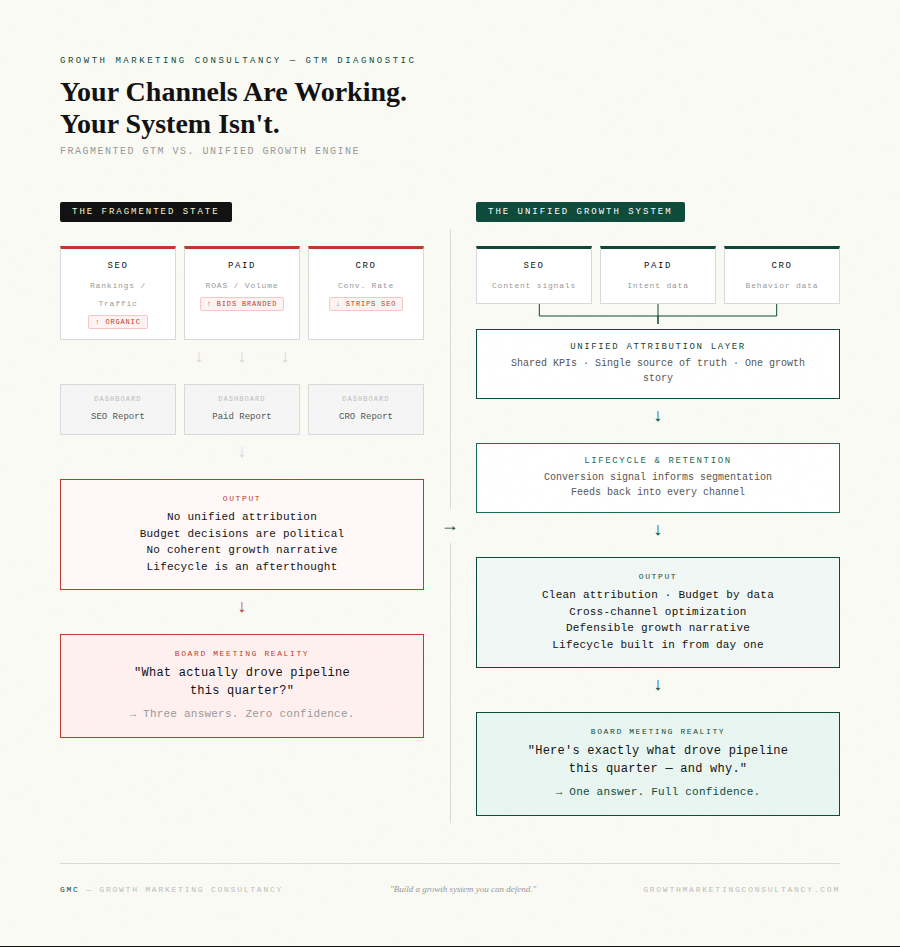
In a unified system, SEO content informs paid targeting — the topics getting organic traction tell you what messaging to test in paid campaigns. Paid click data informs CRO prioritization — you test on the pages where you're already spending money to drive traffic. CRO behavioral data informs SEO — what visitors actually do on the page tells you what content gaps exist in your funnel.
And lifecycle isn't a separate function that activates post-conversion. It's part of the system from the first touchpoint — capturing signal, informing segmentation, and feeding back into every channel.
The output isn't just better performance. It's a coherent growth story you can actually explain to a board.
How to Know If You Have a Fragmentation Problem
You don't need an audit to answer this. Run through these five questions:
If your PE sponsor or CEO asked you tomorrow to explain what drove this quarter's pipeline results, could you give a single, sourced answer — or would you need to reconcile three separate reports first?
Do your SEO, paid, and CRO teams have a shared weekly touchpoint, or do they only interact during quarterly planning?
Is there one person or function that owns the full funnel narrative — from first organic touch to closed-won — or is that accountability split across channels?
Can you identify, with confidence, which content assets are contributing to pipeline versus which ones are generating traffic that never converts?
Does your CRO testing process include a sign-off from SEO before deploying winning variants on pages that rank?
If you answered "no" to three or more of these, fragmentation is already costing you — in wasted spend, missed attribution, and growth that's harder to explain than it should be.
Where to Start
The most common mistake is trying to solve fragmentation with a tool — a new attribution platform, a unified dashboard, a BI layer on top of the existing chaos. Tools don't fix structural problems. They make them more visible.
The place to start is ownership. Someone needs to own the growth system end-to-end — not a channel, not a dashboard, the system. That person's job is to make sure SEO, paid, CRO, and lifecycle are operating around shared goals, shared data, and a shared definition of what a conversion actually means.
For most mid-market teams, that's not a hire. It's a design decision. It's choosing to stop managing channels and start managing a system.
When you make that shift, three things change quickly. Attribution gets cleaner. Budget decisions get less political. And the answer to "what drove growth this quarter" becomes something you can say with confidence in any room.
The Bottom Line
Your channels aren't broken. Your system is fragmented. And fragmented systems produce inconsistent results, expensive attribution debates, and growth narratives that fall apart under scrutiny.
The companies that win in PE-backed environments aren't the ones with the best SEO team or the best paid media team. They're the ones where every channel knows its role in the system — and where that system produces a story leadership can defend.
Building that system isn't complicated. But it does require someone willing to own the whole thing.
Growth Marketing Consultancy builds unified GTM systems for PE-backed and founder-led mid-market companies. If your channels aren't talking to each other, book a Growth System Audit.