
The First 90 Days as a CMO in a PE-Backed Company: What to Audit, What to Fix, and What to Leave Alone
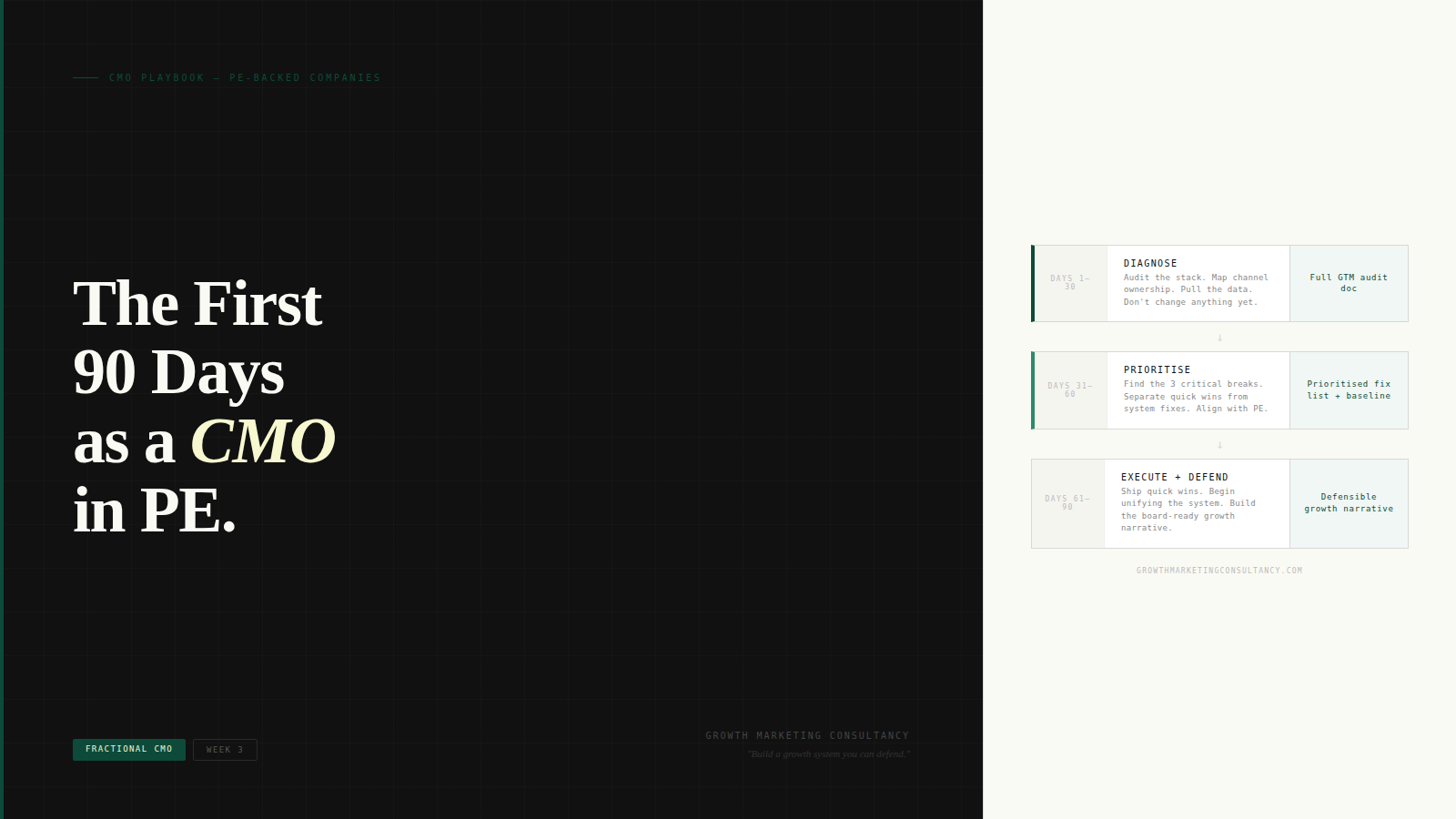
The biggest mistake new CMOs make in PE environments isn't a bad strategy. It's an audit that never happened.
The Clock Nobody Mentions
There's a clock that starts the moment you join a PE-backed company as CMO.
It isn't officially announced. There's no onboarding document that references it. But everyone in the room — the PE operating partner, the CEO, the CFO — knows it exists.
You have roughly 90 days before leadership forms a permanent opinion about whether you're the person who's going to fix the growth engine, or the latest hire who had a lot of good ideas and not enough results.
Most new CMOs fail that window not because they're bad at marketing. They fail because they start in the wrong place.
They audit quickly, conclude fast, and start changing things — vendor contracts, reporting structures, channel strategy, sometimes even team composition — before they actually understand what they've inherited. And in PE-backed environments, that burns political capital you cannot afford to lose.
The companies where I've seen CMOs thrive in their first year share one pattern: they treated the first 90 days as a diagnostic phase, not an execution phase. They understood the system before they tried to fix it.
This is that playbook.
Why PE-Backed Environments Are Different
Before getting into the framework, it's worth naming what makes PE-backed companies a distinct environment — because the dynamics shape everything about how you should operate in the first 90 days.
Reporting pressure is real and immediate. PE firms have quarterly board cadences. You will be asked to explain performance before you've had time to fully understand it. Your ability to tell a coherent, defensible growth story is evaluated from day one — even if the story is "here's what's broken and here's how I'm fixing it."
The political environment is higher-stakes than most. In PE-backed companies, budgets are scrutinised closely, headcount decisions are tied to performance, and the consequence of a wrong call — choosing the wrong agency, launching the wrong initiative, burning spend — is felt quickly. Risk aversion is rational, not timid.
You've almost certainly inherited a mess. Most CMO roles at PE-backed companies open because something wasn't working. The growth engine is fragmented. The reporting is unreliable. The channels aren't integrated. Your predecessor either left or was pushed. You are walking into a system that has been under-managed, over-complicated, or both.
Speed is expected but credibility is earned. PE environments value urgency. But they value defensible decisions more. Moving fast on the wrong things will cost you far more than taking 30 extra days to get the diagnosis right.
The 90-Day Framework
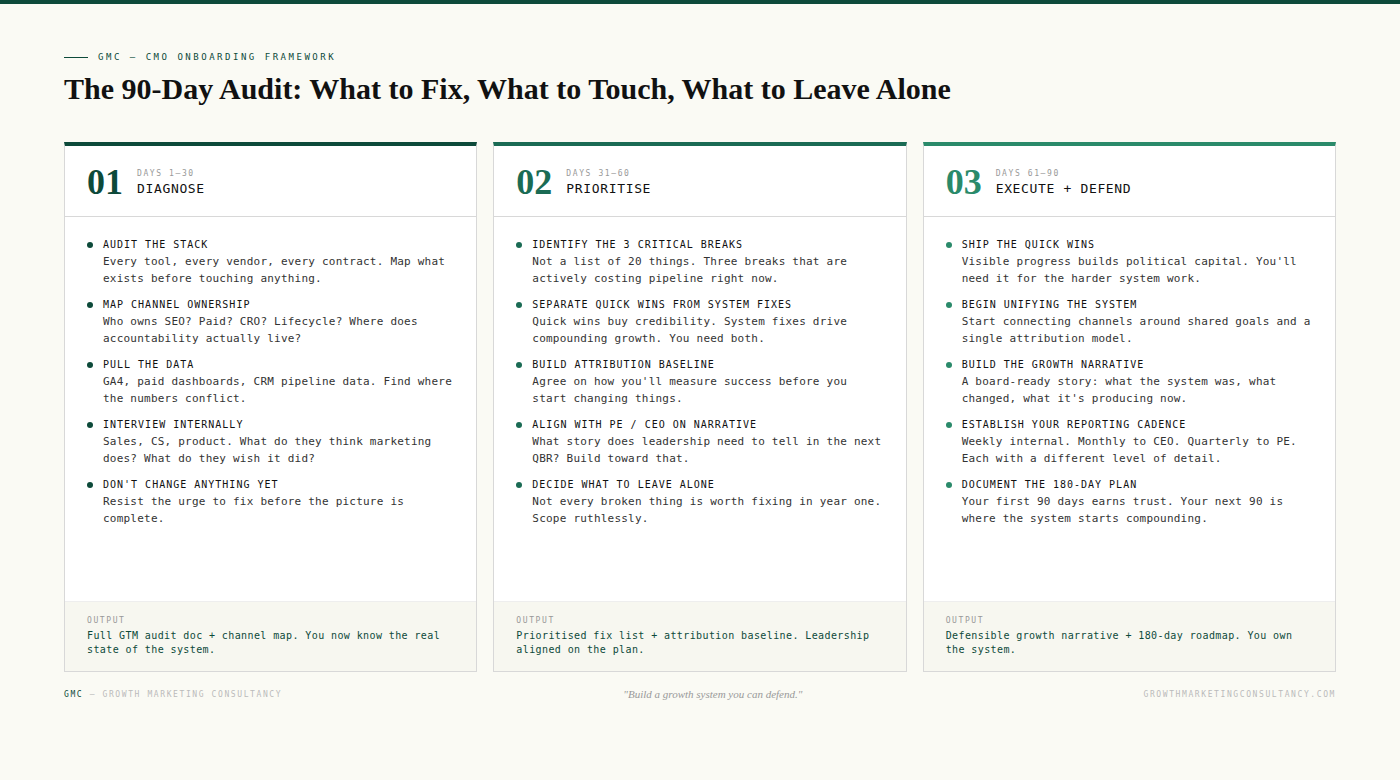
The 90-Day Audit: What to Fix, What to Touch, What to Leave Alone
Days 1–30 Diagnose. Don't Touch Anything.
The first month has one job: understand the full picture before you change a single thing.
This sounds obvious. Almost no one does it.
The pressure to show early momentum is real, and it tempts new CMOs to make visible changes quickly — swap an agency, rewrite the messaging, restructure the team. These moves signal action. They also signal that you don't fully understand what you're working with yet, which is a credibility problem you'll spend months recovering from.
What the diagnostic phase actually involves
Audit the full stackEvery tool, every vendor contract, every recurring spend line. Map what exists in its entirety before forming any opinions about what should change. You will find things that surprise you — redundant tools, contracts that auto-renewed without scrutiny, agencies doing work nobody internally knows about.
Map channel ownershipWho actually owns SEO? Who owns paid? Who is responsible for CRO? Where does lifecycle marketing live? In most mid-market companies, the honest answer is that ownership is fragmented, overlapping, or entirely absent for certain channels. Document this without judgment.
Pull the data across every channelGA4, your paid platform dashboards, CRM pipeline data, email performance, any existing attribution model. Look for where the numbers conflict — and they will. Conflicting numbers tell you where the system is broken.
Interview internally before externallyTalk to sales, customer success, and product before you talk to any vendor or agency. What does sales think marketing does? What do they wish it did? Where does the handoff break down?
Don't change anything yetSeriously. Not a vendor. Not a campaign. Not a reporting format. Observe.
The output of days 1–30 is a complete GTM audit document — a clear picture of every channel, every tool, every owner, and every gap. This document becomes the foundation for everything that follows.
Days 31–60 Prioritise. Ruthlessly.
You now have the full picture. Your job is to identify the three breaks that are actively costing pipeline right now — not a list of twenty improvements, three.
Find the three critical breaks Look for the places where money is being spent and results can't be explained. Look for the channels where ownership is unclear or absent. Look for the data gaps that make it impossible to answer the question "what drove that result?"
Separate quick wins from system fixes Quick wins buy you credibility and political capital. System fixes drive compounding growth but take longer to show results. You need both, and you need to be clear with leadership about which is which.
Build the attribution baseline Before you change anything, agree on how you'll measure success. What counts as a conversion? How is pipeline attributed across channels? What does the reporting cadence look like, and who sees what?
Align with PE and the CEO on the narrative Find out what story leadership needs to tell in the next board update. Build your plan around supporting that narrative — not around what you personally believe is the highest-leverage marketing work.
Decide explicitly what you're not going to touch Not every broken thing is worth fixing in year one. Scope ruthlessly. Attempting to fix everything guarantees you fix nothing well.
"Not every broken thing is worth fixing in year one. Scope ruthlessly. Attempting to fix everything guarantees you fix nothing well."
Days 61–90 Execute. Build the Story.
Phase three is where you start moving — but not everywhere at once.
Ship the quick wins first Visible, fast improvements should be live by now. Not because they're the most important work, but because they demonstrate competence and build the political capital you need for the harder system work ahead.
Begin the system work Start connecting channels around shared goals and a shared attribution model. Shared KPIs, a weekly cross-channel meeting, a single reporting view that everyone uses.
Build the growth narrative A board-ready story: what the system was when you arrived, what you've changed and why, what it's producing now, and where it's going in the next 90 days.
Establish your reporting cadence Weekly internal. Monthly to the CEO. Quarterly to PE. Each with a different level of detail but consistent underlying data.
Document the 180-day plan Your first 90 days earned trust and established the foundation. Your next 90 days is where the system starts compounding. Have this plan written and aligned before day 90.
What to Fix, What to Watch, What to Leave Alone
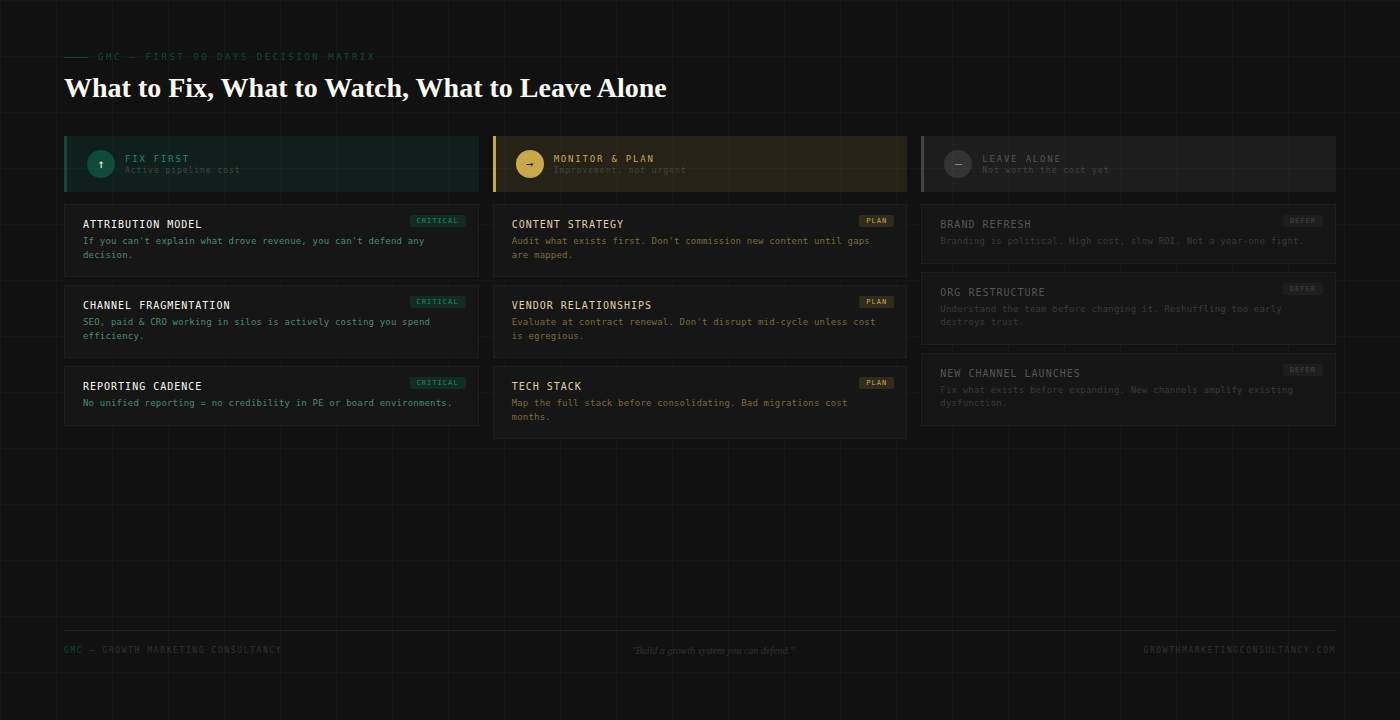
Decision Matrix: Fix First / Monitor & Plan / Leave Alone
The decision matrix above captures the framework at a glance. The "leave alone" column is where most CMOs make their costliest early mistakes — here's the reasoning behind each deferral.
Brand refresh. Every new CMO wants to put their mark on the brand. Resist. Brand work is expensive, slow, and deeply political in PE-backed companies where every spend line is scrutinised. Unless the brand is actively harming commercial performance — and it almost never is — this is not a year-one fight.
Org restructure. You don't know enough about the team in the first 90 days to restructure it well. You may know who's underperforming, but you don't yet know why, what the context is, or what you'd lose by moving them. Understand the team before changing it.
New channel launches. The instinct to expand — add TikTok, launch a podcast, test out-of-home — should be suppressed entirely in the first 90 days. New channels amplify existing dysfunction. Fix what exists before building on top of it.
The Real Output of the First 90 Days
The metrics matter. The quick wins matter. The system work matters.
But the real output of a successful first 90 days in a PE-backed company is something less tangible and more important: you become the person who understands the system.
Not the person who arrived with a playbook and executed it regardless of what they found. Not the person who made a lot of visible changes in week two and then spent six months explaining why the numbers didn't move. The person who took the time to understand the machine before touching it — and who can now speak about it with the clarity and confidence that PE environments demand.
The Bottom Line
The 90-day clock is real. But what it's actually measuring isn't how fast you can move. It's whether you understand what you're working with well enough to defend every decision you make.
That credibility is the foundation everything else is built on.
Growth Marketing Consultancy works with PE-backed and founder-led mid-market companies to build unified growth systems that produce a predictable pipeline and defensible reporting. If you're a new CMO navigating the first 90 days, book a Growth System Audit.