
Why Hiring Another Agency Won't Fix Your Growth Problem
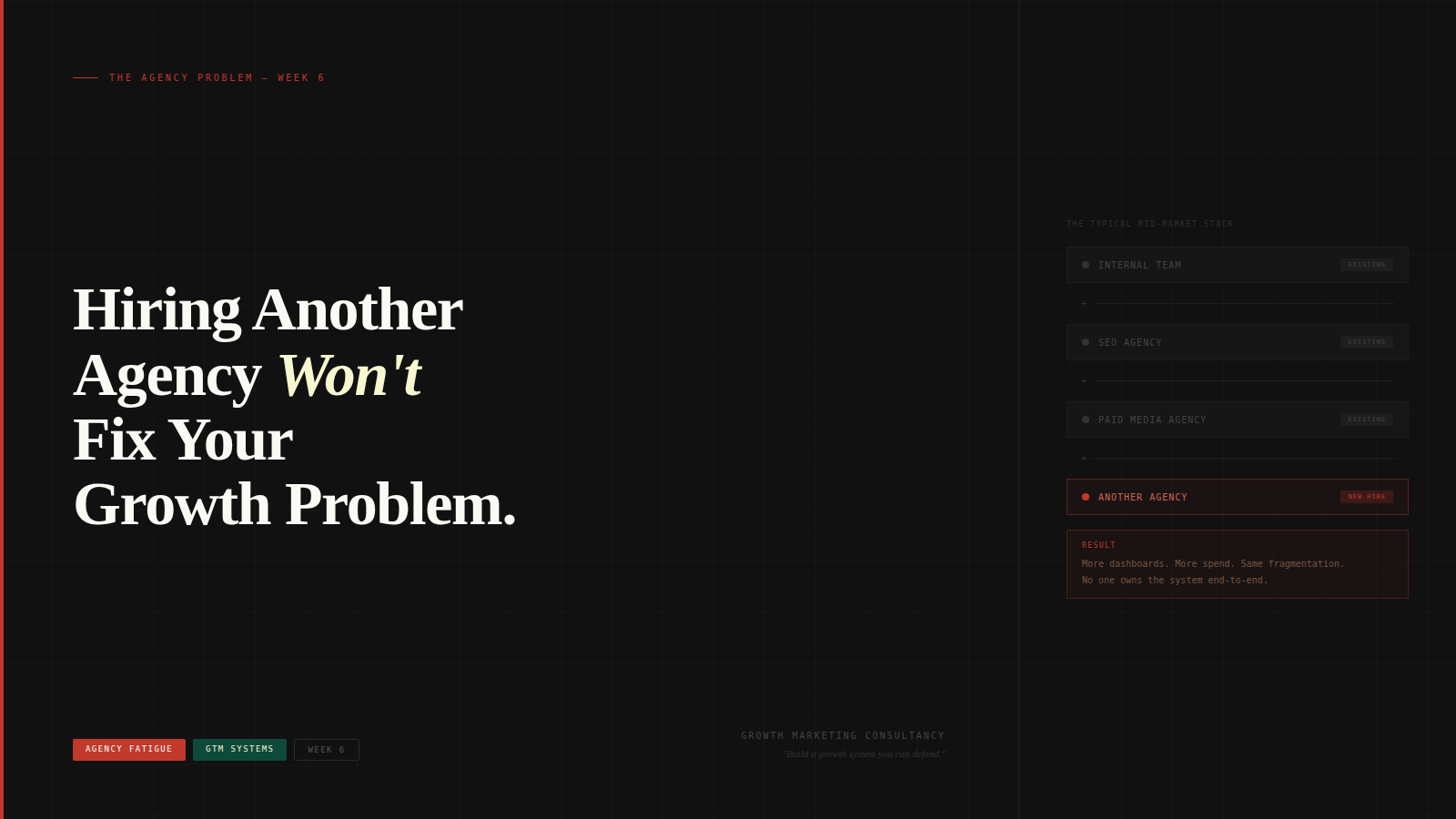
Every agency you've hired solved a piece of the problem. None of them were incentivised to solve the whole thing.
The Pattern Nobody Wants to Admit
Here's how it usually goes.
Growth plateaus. Pipeline gets inconsistent. Leadership starts asking questions. The diagnosis — delivered either internally or by a consultant — is that you need better SEO, or stronger paid, or a proper CRO programme. So you hire an agency to fix it.
Six months later, the channel they own is performing better. But pipeline still isn't where it needs to be. So you add another agency for the next weakest channel. Then another.
Before long you have four vendors, five dashboards, a weekly meeting with each of them, and a reporting process that takes your team three days to pull together every month. And when the PE sponsor asks what actually drove pipeline growth last quarter, nobody has a clean answer — because nobody owns the full picture.
This is not a story about bad agencies. Most of them are doing exactly what they were hired to do. This is a story about a structural problem that more agencies cannot fix — and in fact make worse every time you add one.
Why Adding Agencies Deepens the Problem
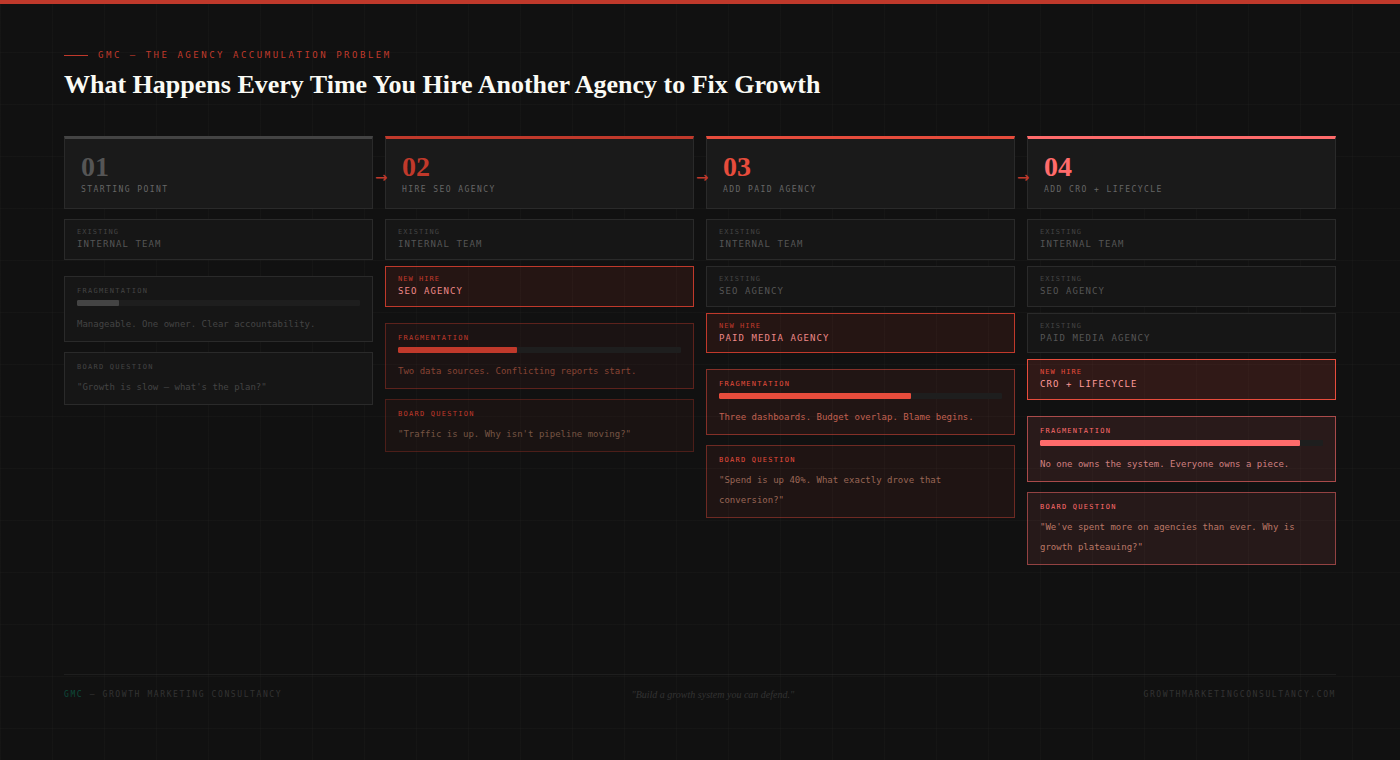
What Happens Every Time You Hire Another Agency to Fix Growth
Every time you add an agency to solve a channel problem, three things happen simultaneously.
Fragmentation increases. Each agency operates inside its own reporting environment, optimising for its own metrics, with its own definition of what success looks like. SEO measures rankings and organic traffic. Paid measures ROAS and volume. CRO measures conversion rate on the pages they touch. Lifecycle measures open rates and click-throughs. None of these metrics are wrong. None of them tell you what actually drove pipeline.
Attribution gets harder. As the vendor count grows, the question "what drove that result?" becomes genuinely unanswerable. Every agency can point to their dashboard and claim credit. No single dashboard connects the dots. Budget decisions become political rather than analytical — the loudest channel wins, not the most efficient one.
Nobody owns the system. This is the core problem. Each agency owns a channel. Your internal team manages the agencies. But nobody owns the growth system end-to-end — the logic that connects SEO to paid to CRO to lifecycle into a single, coherent demand generation engine. That absence is where growth gets lost.
The Incentive Problem Nobody Talks About
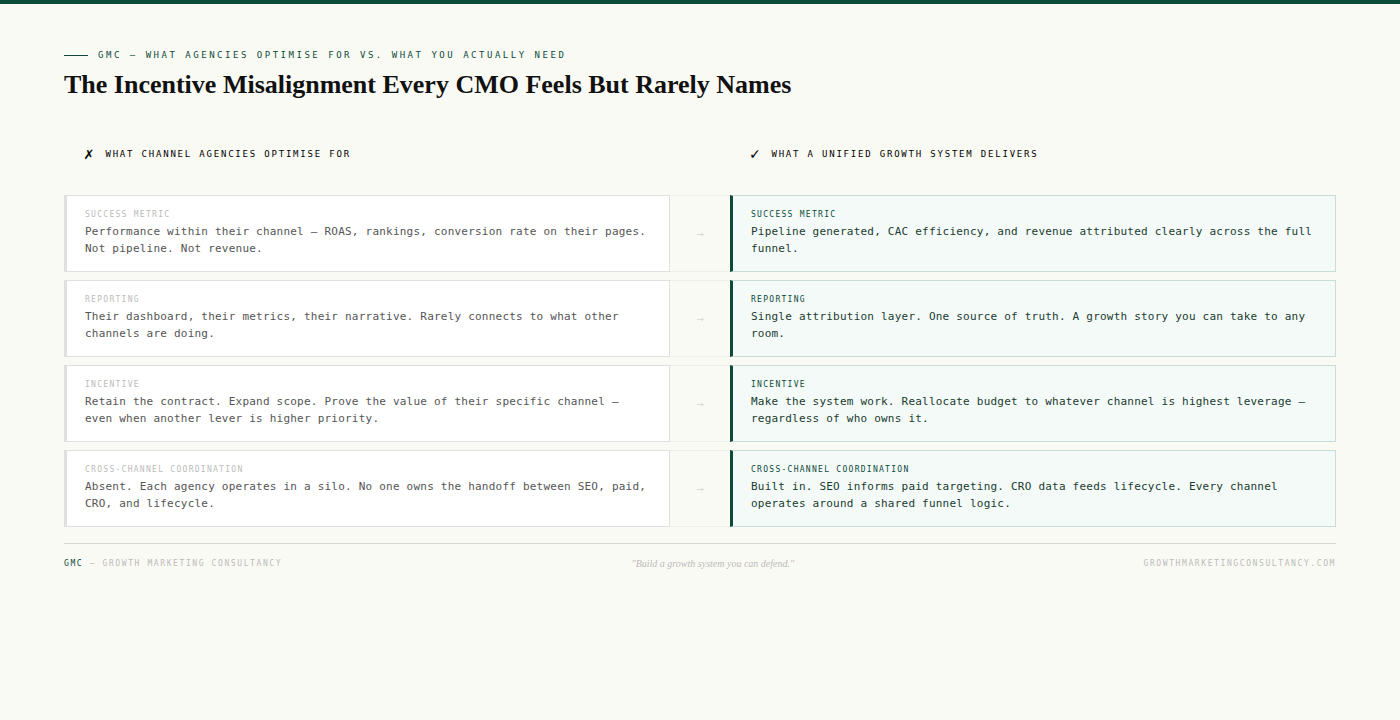
What Agencies Optimise For vs. What You Actually Need
There's a more uncomfortable truth underneath the fragmentation problem, and it's worth naming directly.
Agencies are not incentivised to solve your whole problem. They are incentivised to retain their contract and expand their scope.
That means a paid media agency will always make the case for more paid budget. An SEO agency will always find more content gaps to fill. A CRO agency will always find more tests to run. They're not being dishonest — they genuinely believe in their channel. But their incentive structure makes them constitutionally unable to tell you that a different channel would be higher leverage right now, or that the real problem is the absence of integration rather than underperformance in any single channel.
The result is a vendor landscape where everyone is telling you their channel is the priority, nobody is telling you the system is broken, and you're paying for all of them.
A unified growth system has a different incentive structure entirely. The goal is not to justify any single channel's existence. The goal is to make the system produce pipeline — and to reallocate budget, attention, and effort toward whatever is highest leverage at any given moment, regardless of who owns it.
What You're Actually Missing
The companies that solve this problem don't do it by finding better agencies. They do it by changing the operating logic entirely.
Instead of managing channels, they build a system. And a system has four properties that a collection of agencies never will.
Shared attributionOne model for how conversions are credited, one dashboard that everyone — internally and externally — operates from. Not because it's perfect, but because consistency in measurement is more valuable than precision that only one vendor can access.
Cross-channel coordinationSEO content informs paid targeting. Paid click data informs CRO prioritisation. CRO behavioural data informs lifecycle segmentation. The channels talk to each other because someone owns the logic connecting them, not just the channels themselves.
A single growth narrativeWhen the PE sponsor asks what drove pipeline last quarter, there is one answer. Not four dashboards worth of partial credit. One story, sourced from one model, told by one person who owns the whole picture.
Budget allocation by data, not politicsWhen a single owner is accountable for the full system, budget decisions become analytical. You move spend toward what's working because you can actually see what's working — not because an agency made a compelling case for their channel in their monthly report.
The Argument for Your CFO and PE Sponsor
If you're reading this and recognising your own stack, the challenge isn't convincing yourself. It's convincing leadership that the problem isn't fixable with another vendor hire.
Here's the framing that lands:
The case for your next board conversation
The issue is not that your channels are underperforming. The issue is that your channels are not integrated — and unintegrated channels produce three predictable outcomes: conflicting attribution, inefficient spend, and a growth narrative you can't defend in a board meeting. Adding another agency adds another channel to the fragmentation problem. It does not solve the fragmentation problem.
What solves it is a single owner of the growth system — someone whose accountability is not a channel but the full funnel, whose incentive is not to justify their own scope but to make the system produce pipeline, and whose primary deliverable is not a dashboard but a defensible, board-ready growth narrative.
That owner might be a fractional CMO. It might be a new internal hire. It might be a restructure of how your existing team is organised. The form matters less than the principle: someone has to own the whole thing, or nobody does.
What to Do Instead
If you're at the point where agency sprawl is the problem, the fix is not additive. It's integrative.
Map what you actually have. Every vendor, every tool, every channel, every reporting line. Most mid-market companies have never done this comprehensively, and the picture is usually worse than expected — redundant tools, overlapping agency scopes, campaigns running that nobody internally remembers commissioning.
Identify the three breaks costing pipeline. Not a list of improvements — three specific places where money is being spent and results can't be explained, or where channel handoffs are breaking down.
Build the attribution baseline. Agree on how success is measured before changing anything. Without this, every improvement is contested and every setback becomes political.
Then make vendor decisions. Not from a position of "which channel needs help" but from "which channels need to exist in a unified system, and who is the right operator to own each one within that system."
The question stops being "should we hire a new SEO agency?" and starts being "what role does SEO play in our unified growth system, and are our current operators equipped to play that role within a system-level operating model?"
That shift — from channel management to system ownership — is what actually fixes the growth problem.
The Bottom Line
You don't have a channel problem. You have a fragmentation problem.
And the thing about fragmentation is that it gets worse every time you add a new piece without changing the underlying operating logic. Another agency, another dashboard, another monthly report that doesn't connect to anyone else's monthly report.
The companies that build defensible, predictable growth engines in PE-backed environments aren't the ones with the most sophisticated channels. They're the ones where every channel knows its role in the system — and where there is one person, one model, and one narrative that connects all of it.
That's not an agency. That's a system.
Growth Marketing Consultancy builds unified GTM systems for PE-backed and founder-led mid-market companies. If agency sprawl is costing you pipeline and clarity, book a Growth System Audit.