
Six Dashboards, Zero Clarity: How to Build a Single Source of Truth for Your Growth Team
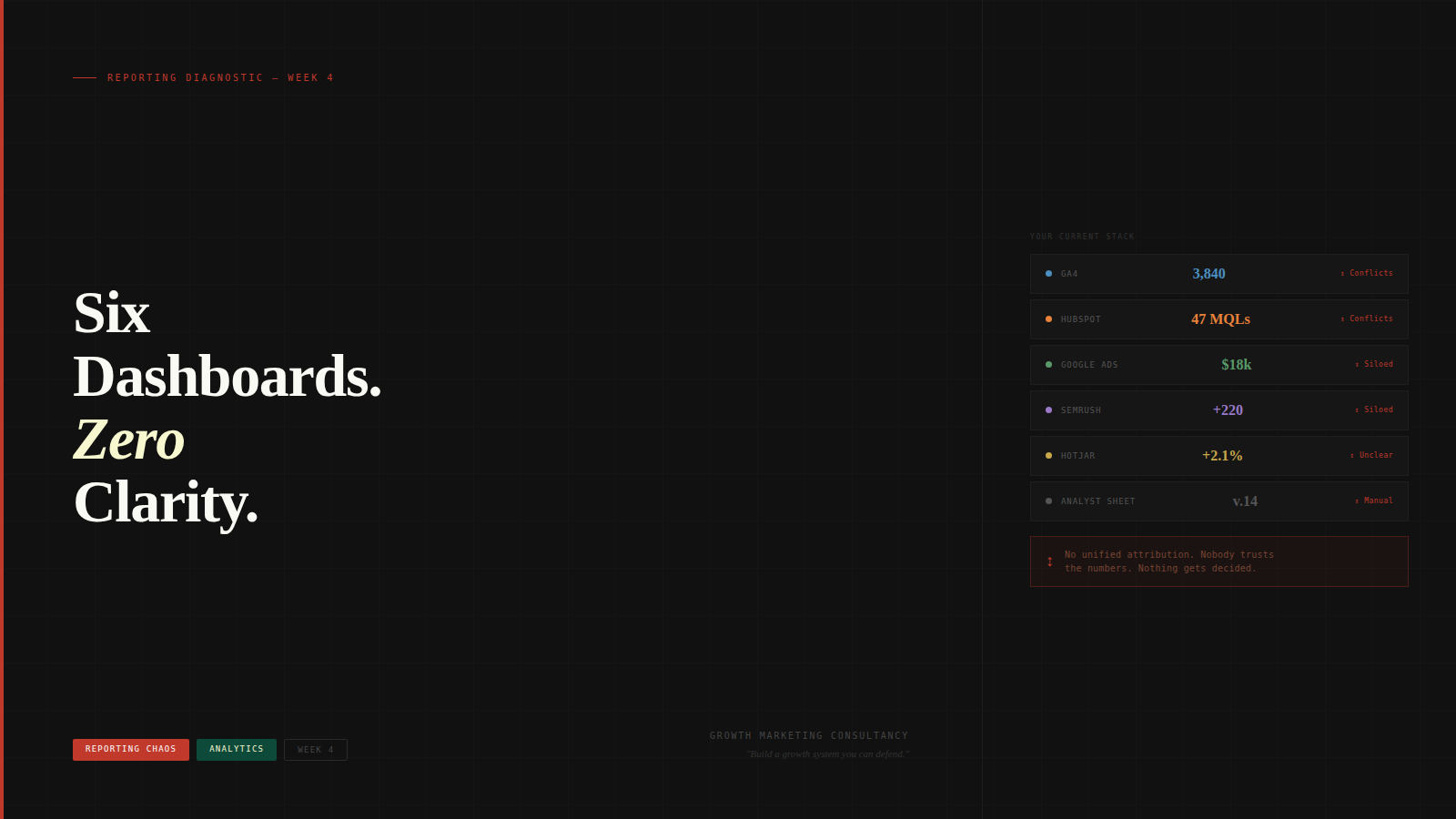
When everyone has different numbers, no one trusts them. And when nobody trusts the numbers, nothing gets decided.
The Archaeology Problem
Here's a scene that plays out in almost every mid-market company I work with.
It's the week before the quarterly board update. Someone needs to answer a simple question: what drove pipeline growth this month?
So they open GA4 for traffic. HubSpot for leads. The paid platform for conversion data. SEMrush for SEO performance. The CRO tool for landing page results. And the spreadsheet their analyst built in 2022 that everyone secretly uses but nobody officially trusts.
Six tools. Six different numbers. Three of them conflict with each other in ways nobody can explain. The paid team says conversions are up. GA4 says traffic is flat. HubSpot shows 47 MQLs. Salesforce shows 31. The 16-MQL gap lives somewhere between the two systems, unattributed and unexplained.
By the time you've reconciled enough of it to write a board update, two days have passed and you still can't say with confidence what actually drove the results.
This is not a data problem. Every one of those tools is producing accurate data within its own context. This is a coherence problem — and it's one of the most expensive, invisible drains on growth team performance in mid-market companies.
Why Six Dashboards Costs More Than You Think
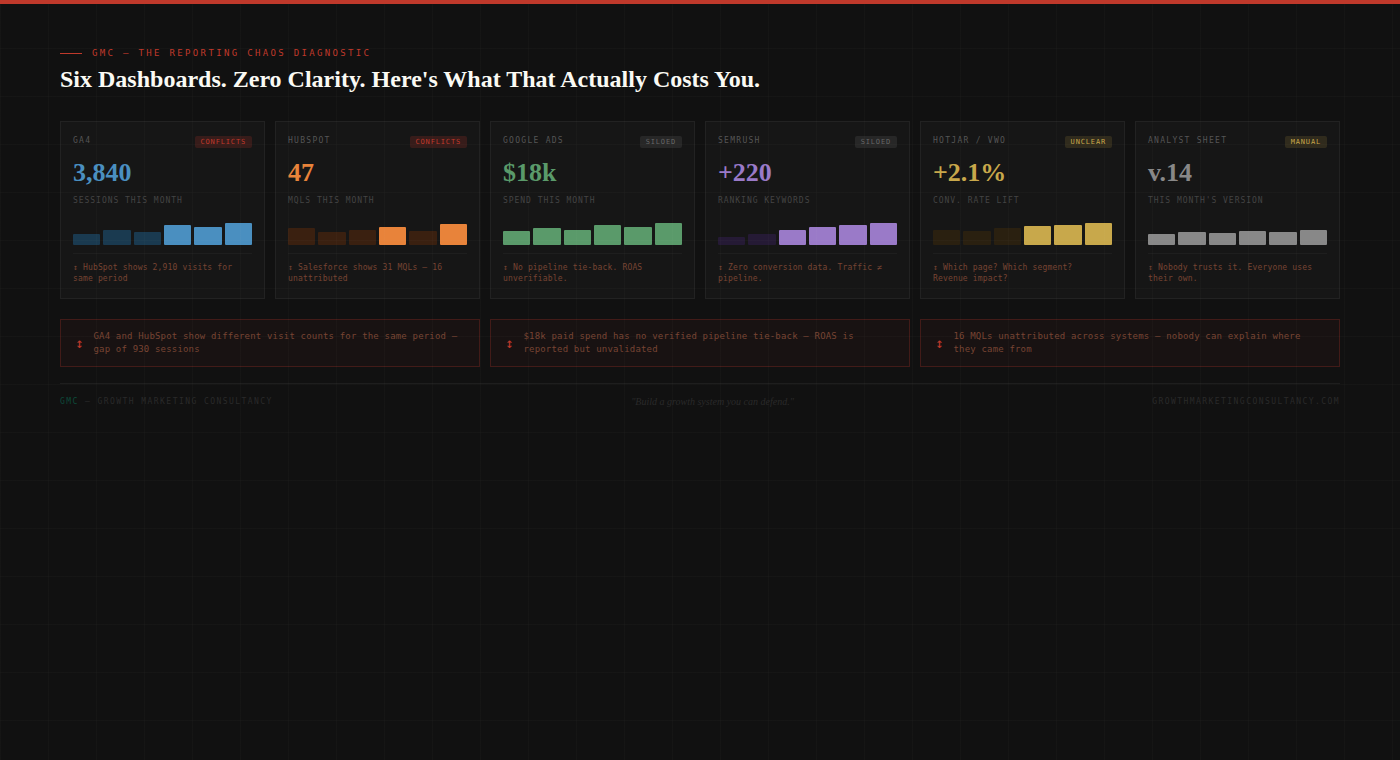
The obvious cost is time. Three days a month to produce a reporting pack that should take three hours. Multiply that across a year and you've lost a month of your team's capacity to archaeology instead of execution.
But the hidden costs are larger.
Decisions don't get made. When attribution is contested — when paid claims the conversion, SEO claims the assisted touch, and CRO claims the lift — budget allocation becomes political. Nobody wants to make a call that another team can point to as wrong using their own dashboard. So decisions get deferred, hedged, or made based on whoever argued most convincingly in the last meeting rather than what the data actually shows.
Trust erodes. Once leadership has seen enough conflicting reports, they stop trusting the numbers altogether. And a marketing team whose numbers aren't trusted doesn't get budget, doesn't get headcount, and doesn't get the runway to build anything that compounds. Credibility is the currency. Fragmented reporting spends it faster than any bad campaign.
The growth narrative breaks down. In PE-backed companies especially, the ability to tell a coherent, defensible story about what drove growth is not optional. When your reporting is fragmented, your narrative is fragmented. And a fragmented narrative in a board meeting is one of the fastest ways to lose confidence — not because the results are bad, but because you can't explain the ones that were good.
The Root Cause Nobody Fixes
Most companies respond to reporting chaos by adding another tool. A BI layer. A dashboard aggregator. Another analyst to reconcile the conflicts.
This makes the problem more visible, not more solved.
The root cause of reporting chaos is not insufficient tooling. It is the absence of an agreed attribution model — a shared, documented definition of how credit is assigned across channels, what counts as a conversion, and which system is the source of record when numbers conflict.
Without that agreement, every tool is technically correct and collectively useless. GA4 counts sessions by its own logic. HubSpot counts contacts by its own logic. Paid platforms count conversions by their own logic. None of them are wrong. But none of them are speaking the same language, and nobody has decided which language is authoritative.
The fix starts there. Not with a new tool. With a decision.
What a Single Source of Truth Actually Looks Like
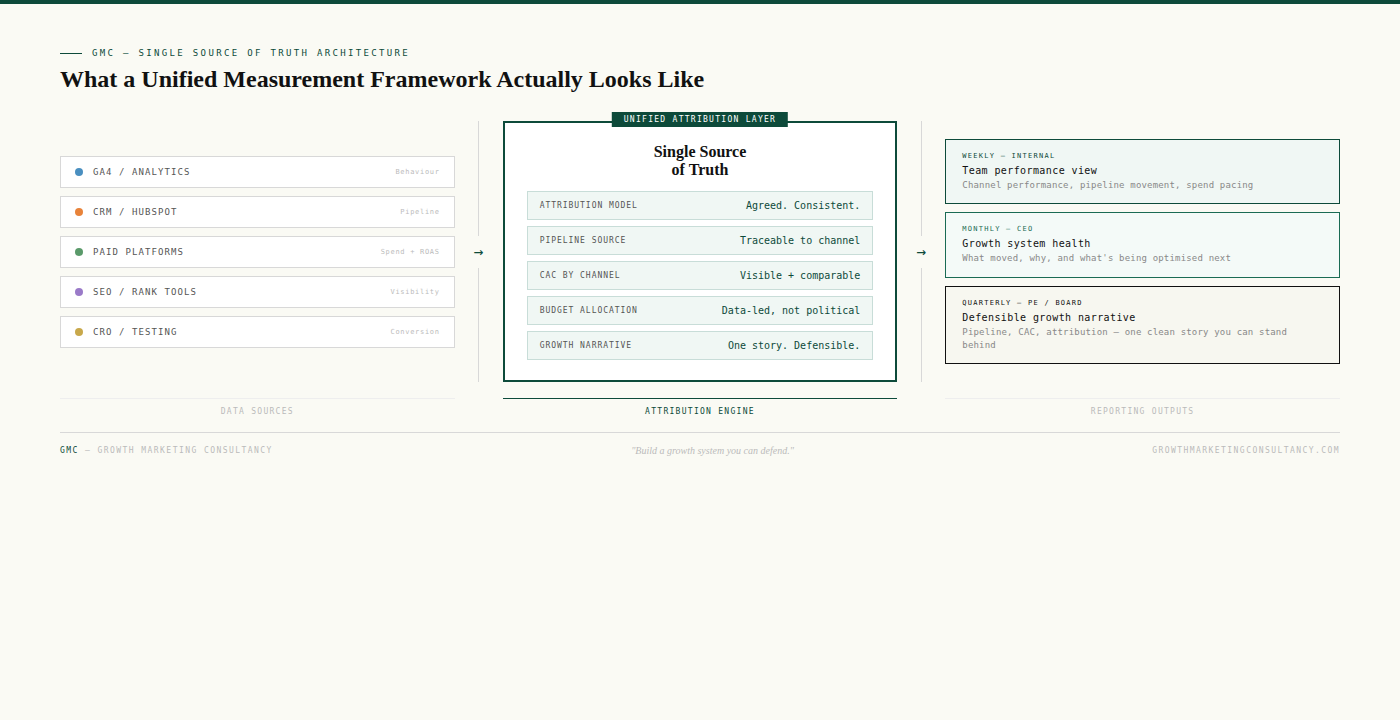
A single source of truth is not one dashboard that replaces all the others. Your channel tools still exist. GA4 still tracks behaviour. HubSpot still manages contacts. Paid platforms still report spend.
What changes is the layer above them — a unified attribution model that takes data from all those sources and produces one consistent, agreed answer to the questions that actually matter for growth decisions.
Those questions are:
What sourced this pipeline? Not what touched it last, not what assisted it — what actually sourced it, by a definition that sales, marketing, and finance have all agreed on in advance.
What is our CAC by channel? Not the number each channel reports for itself, but the actual cost of customer acquisition when pipeline is attributed consistently across all spend.
What is working and what isn't? A question that is unanswerable when every channel reports in its own system and a genuinely answerable when there is one model connecting them all.
What is the growth story this quarter? The board-ready narrative that doesn't require three days of reconciliation because it flows directly from data everyone already trusts.
How to Build It Without Rebuilding Everything
The good news is that building a single source of truth does not require replacing your tech stack. It requires four things, in order.
Step one: Agree on attribution before changing any tooling. Sit down with sales, finance, and whoever owns each marketing channel and answer three questions: what counts as a conversion, which system is the source of record for pipeline, and how do we handle multi-touch attribution when a lead has been touched by both organic and paid. Document the answers. Get sign-off. This conversation will be uncomfortable. It is the most valuable hour you will spend on this problem.
Step two: Identify the three conflicts that matter most. Not every data discrepancy is worth solving. GA4 and HubSpot will never agree on session counts — that's a known structural difference between how they track. But the gap between MQLs in your marketing platform and opportunities in your CRM is worth solving, because that's where revenue attribution lives. Prioritise the conflicts that sit in the path of pipeline.
Step three: Pick one system as the revenue source of record. Usually this is your CRM — HubSpot, Salesforce, or equivalent — because that's where pipeline and closed-won data actually lives. Every other tool feeds into it or is reconciled against it. GA4 tells you about traffic. Your CRM tells you about revenue. When they conflict, the CRM wins.
Step four: Build one reporting view that everyone uses. This does not have to be sophisticated. A well-structured Looker Studio dashboard pulling from your CRM and your paid platforms, updated weekly, shared with everyone who owns a channel — that is enough to replace six conflicting dashboards and three days of monthly archaeology. The goal is not perfection. The goal is a consistent number that everybody trusts enough to make decisions from.
The Reporting Cadence That Makes It Stick
A single source of truth only holds if the organisation uses it. That means building a reporting cadence that connects to how decisions are actually made.
Weekly — internal team. Channel performance, pipeline movement, spend pacing. Short. Shared. Everyone operates from the same view.
Monthly — CEO. What moved, why it moved, and what's being optimised next. One page. No archaeology.
Quarterly — PE or board. Pipeline, CAC, attribution. A clean, sourced growth narrative that answers "what drove results this quarter?" in a single, confident answer.
The cadence only works if the underlying data is consistent. But once it is, the reporting practically writes itself — because you're pulling from one model instead of reconciling six.
The Question Worth Answering
There is one question that separates companies with a real growth system from companies that are just running channels: can you answer, right now, without opening more than one tool, what drove pipeline this quarter?
If the answer is yes — you have a single source of truth, whether or not you've named it as such.
If the answer is no — the fragmentation is costing you more than time. It's costing you the ability to make confident decisions, earn trust with leadership, and build a growth narrative that holds up in any room.
That's what a single source of truth actually gives you. Not cleaner data. A defensible story.
Growth Marketing Consultancy builds unified GTM systems for PE-backed and founder-led mid-market companies. If your reporting is fragmented and your growth narrative isn't holding up, book a Growth System Audit.