
How to Build a Growth Narrative You Can Defend in a PE Board Meeting
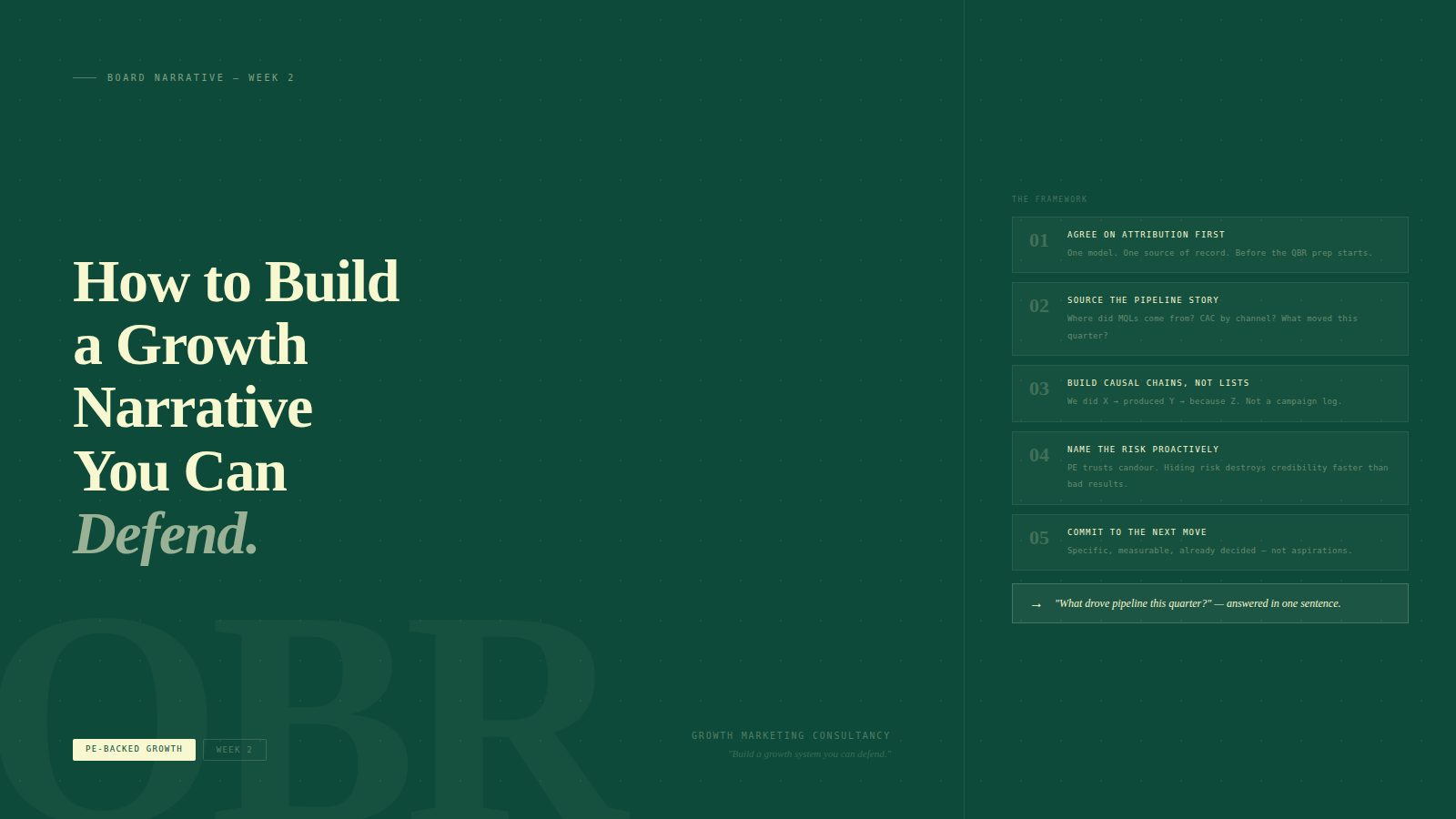
The problem isn't that your growth results were bad. It's that you couldn't explain the ones that were good.
The Silence in the Room
There's a specific kind of silence in a PE board meeting.
It happens when the operating partner asks "so what actually drove pipeline growth this quarter?" — and the CMO opens three tabs, references two dashboards that don't agree with each other, and produces an answer that sounds like a hedge rather than a fact.
The results might be fine. The strategy might be sound. But in that moment, confidence evaporates — because the story isn't defensible. And in PE-backed environments, an indefensible growth narrative is almost as damaging as a bad one.
This is the most common problem I see with mid-market CMOs who are technically doing good work. The channels are performing. The team is executing. But the narrative connecting it all — the story that explains what's working, why it's working, and what's coming next — doesn't exist in a form anyone can stand behind.
This post is the framework for building it. Not from scratch, and not after the next QBR — from the data you already have, before your next board update.
Why Most Growth Narratives Fall Apart Under Pressure
A growth narrative fails in a board meeting for one of three reasons.
It's sourced from multiple conflicting systems. GA4 says one thing. HubSpot says another. The paid platform claims credit for conversions the CRM doesn't recognise. When the underlying data conflicts, the narrative built on top of it collapses under the first follow-up question.
It describes activity instead of causality. "We ran 14 campaigns, published 22 blog posts, and tested 6 landing page variants" is not a growth narrative. It's a task list. A board wants to know what moved pipeline and why — not what your team was busy doing.
It has no forward commitment. A retrospective account of what happened, with no clear decision about what comes next, signals that marketing is reactive rather than systematic. PE sponsors want to see a team that learns from data and acts on it — not one that reports it and moves on.
All three problems have the same root cause: there's no single, agreed model connecting the data to the decisions to the outcomes. The fix is building that model before the next QBR, not during it.
The Five Components of a Board-Ready Growth Narrative
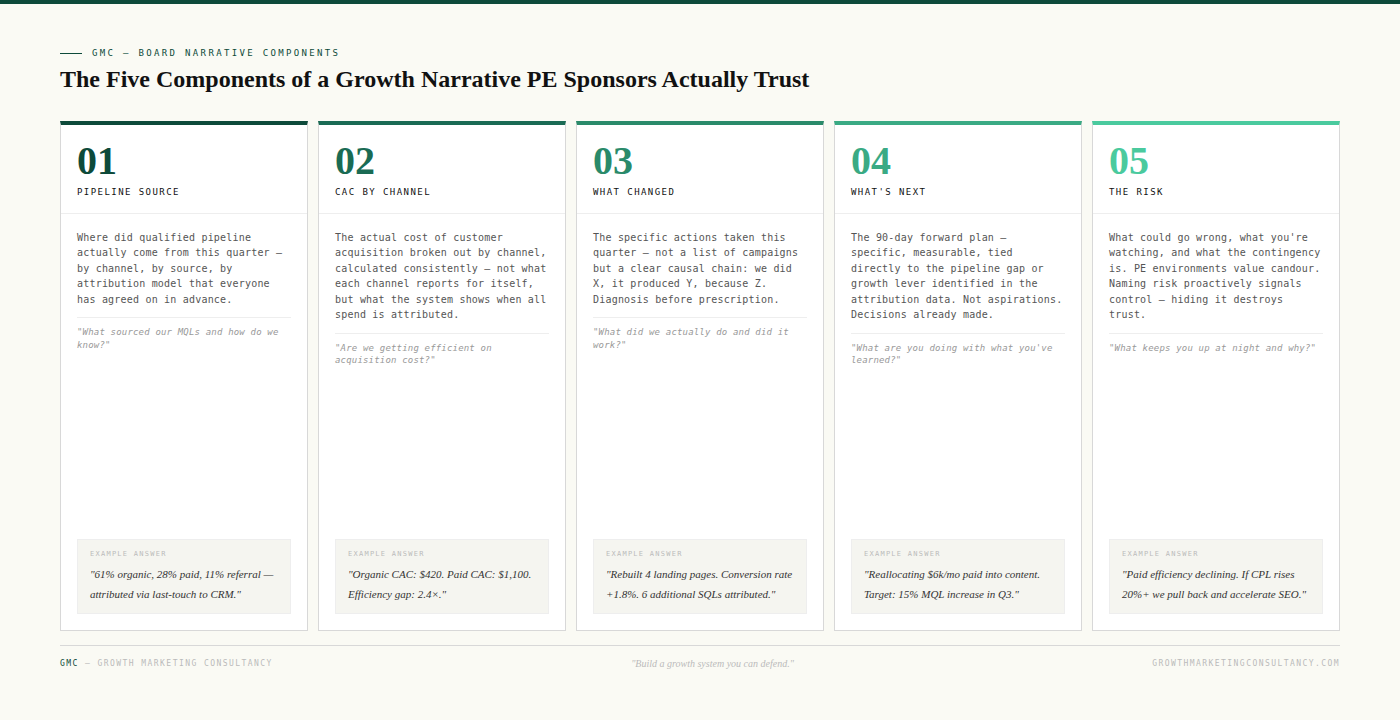
A defensible growth narrative is not a long document. It's five answers to five questions, sourced from one consistent model, that anyone in the room can verify and nobody can contest.
Component 1: Pipeline source. Where did qualified pipeline actually come from this quarter — by channel, by source, by an attribution model that marketing, sales, and finance have agreed on in advance. This is the foundational question. If you can't answer it cleanly, nothing else in the narrative holds.
Component 2: CAC by channel. The actual cost of customer acquisition broken out by channel, calculated consistently. Not what each channel reports for itself — what the system shows when all spend is attributed through the same model. This number is what allows you to make a defensible case for budget allocation.
Component 3: What changed and what it produced. The specific actions taken this quarter and their measurable outcomes — not a campaign log, but a causal chain. We rebuilt four landing pages. Conversion rate improved 1.8%. Six additional SQLs are directly attributed. That's a story. That's defensible.
Component 4: What comes next. The 90-day forward plan — specific, measurable, already decided. Not aspirations. Not "we're exploring". Decisions that have been made based on what the data showed. This is the component that separates a reporting function from a growth function.
Component 5: The risk. What could go wrong, what you're watching, and what the contingency is. This is the component most CMOs skip, and it's the one that builds the most credibility with PE sponsors. Naming risk proactively signals that you're in control of the system. Hiding it signals that you're not.
From Messy Data to Defensible Story
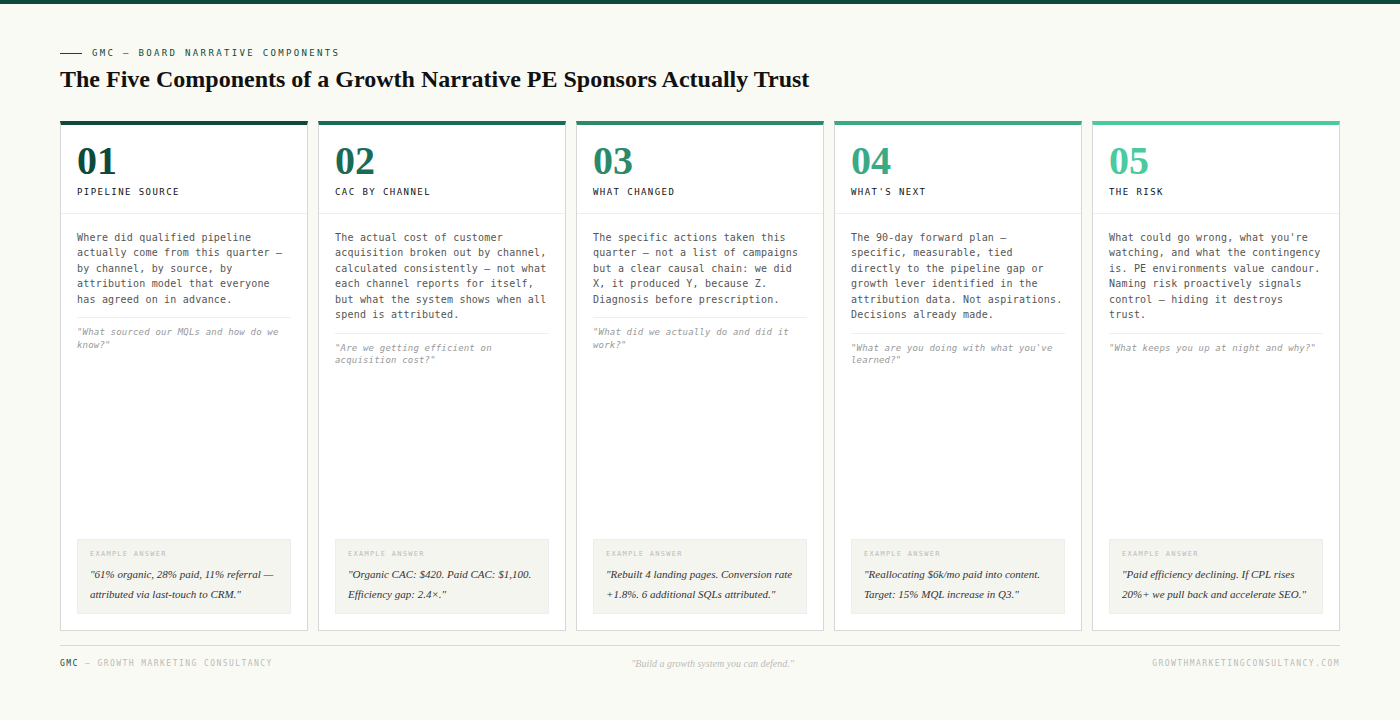
The transformation above is not theoretical. It's a process — and it starts with one decision that most teams defer until it's too late.
Agree on attribution before QBR prep begins.
This is the step that makes everything else possible. Sit down with sales, finance, and whoever owns each marketing channel and answer three questions: what counts as a conversion, which system is the source of record for pipeline, and how do we handle touches that cross multiple channels.
Document the answers. Get sign-off from everyone in the room. This conversation is uncomfortable — there will be disagreement about which system is right, whose numbers are accurate, and who gets credit for what. Have it anyway. The discomfort of that conversation is infinitely smaller than the discomfort of a board meeting where your numbers don't hold up.
Once attribution is agreed, the rest of the narrative builds quickly — because you're no longer reconciling conflicting data. You're telling one story from one source.
The QBR Prep Process That Actually Works
Most CMOs spend QBR week pulling reports, reconciling dashboards, and writing a narrative that tries to make fragmented data tell a coherent story. That process produces hedged answers and defensive postures.
Here's a different approach.
Week before QBR: Run the attribution pull. From your agreed source of record — usually your CRM — pull pipeline by source for the quarter. Calculate CAC by channel using total spend divided by attributed pipeline, using the same denominator for every channel. This takes two hours if the model is already built, two days if it isn't.
Two days before: Build the causal chain. For each major initiative of the quarter, write one sentence: we did X, it produced Y, because Z. If you can't write that sentence, the initiative doesn't go in the narrative — it goes in a separate operations update. The board doesn't need to know everything. They need to know what moved pipeline.
Day before: Write the risk section first. Most people write this last as an afterthought. Writing it first forces clarity about what you're actually uncertain about — and it makes the forward commitment more credible, because it's grounded in an honest assessment of what could go wrong.
Day of: One page, five sections. Pipeline source. CAC by channel. What changed. What's next. The risk. That's the board narrative. Everything else is backup for follow-up questions.
What to Do When the Data Is Still Messy
If you're reading this in the week before a QBR and your reporting is still fragmented, the full framework isn't available to you yet. But a version of it is.
Use your CRM as the source of record for pipeline, even if it's imperfect. It's better to have one consistent number that's slightly wrong than three conflicting numbers that are each slightly right in their own context.
For attribution, use the simplest model that you can defend: last-touch to the channel that sourced the MQL. It's not perfect — multi-touch attribution is more accurate — but it's consistent, explainable, and verifiable. That's what matters in a board room.
For the forward commitment, be specific about timeline and metric, and frame it as a decision already made rather than a plan under consideration. "We're increasing SEO investment by 30% next quarter, targeting a 15% MQL improvement by September, because organic CAC is 2.4× more efficient than paid" is defensible. "We're exploring organic growth opportunities" is not.
The goal for this QBR is not a perfect narrative. It's a credible one — a story that holds up under questioning because every number in it is sourced, every claim is attributable, and every forward commitment is already decided.
The Compounding Effect of Narrative Credibility
There's something that happens when a CMO walks into a PE board meeting with a clean, defensible growth narrative — and it's not just about surviving the QBR.
It changes how the rest of the conversation goes. Budget requests land differently when they're grounded in a clear attribution story. Headcount cases are more convincing when they're tied to a specific pipeline gap the data shows. Vendor decisions are easier to defend when the underlying measurement framework is trusted by everyone in the room.
The growth narrative is not just the story you tell in the meeting. It's the foundation of every growth decision you make between meetings. When it's built properly — on one consistent model, updated quarterly, trusted by sales, finance, and the PE sponsor — it becomes the operating system for the growth function.
That's what defensibility actually produces. Not just a better board meeting. A growth function that makes better decisions because it's operating from the same facts as everyone else.
Growth Marketing Consultancy builds unified GTM systems for PE-backed and founder-led mid-market companies. If your next QBR is coming up and your growth narrative isn't where it needs to be, book a Growth System Audit.