
Why AI Won't Fix a Fragmented GTM — And What to Do First
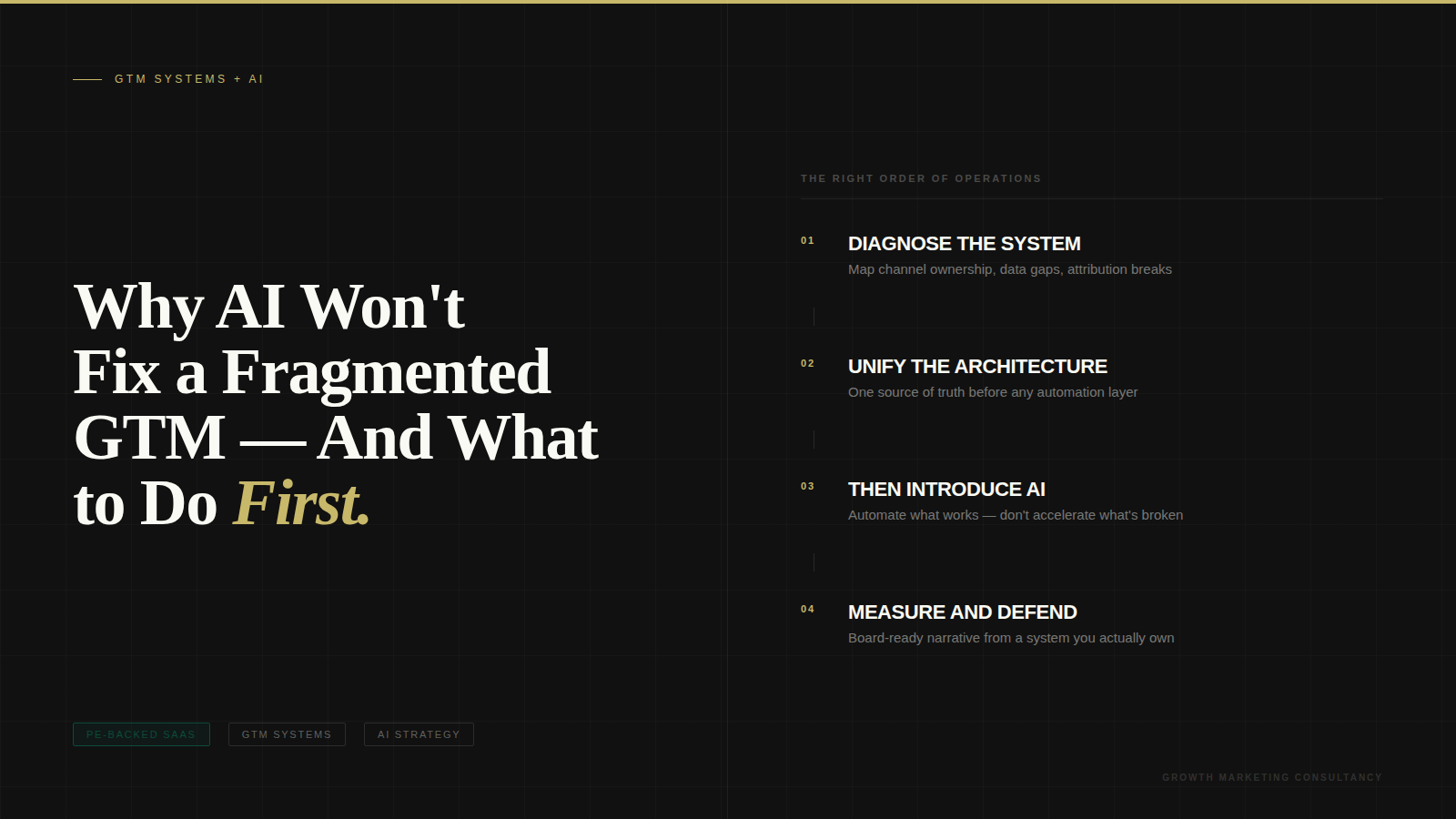
Most PE-backed marketing teams are buying AI tools to fix a growth problem that isn't a technology problem.
The thinking is understandable. AI can generate content at scale, model attribution, automate lifecycle sequences, and surface reporting insights in seconds. If growth is stalled and the board is asking questions, AI feels like a fast answer.
It isn't.
The reason growth is stalled in most mid-market PE-backed companies has nothing to do with the tools. It has everything to do with the system underneath them — or more precisely, the absence of one.
The Amplification Problem
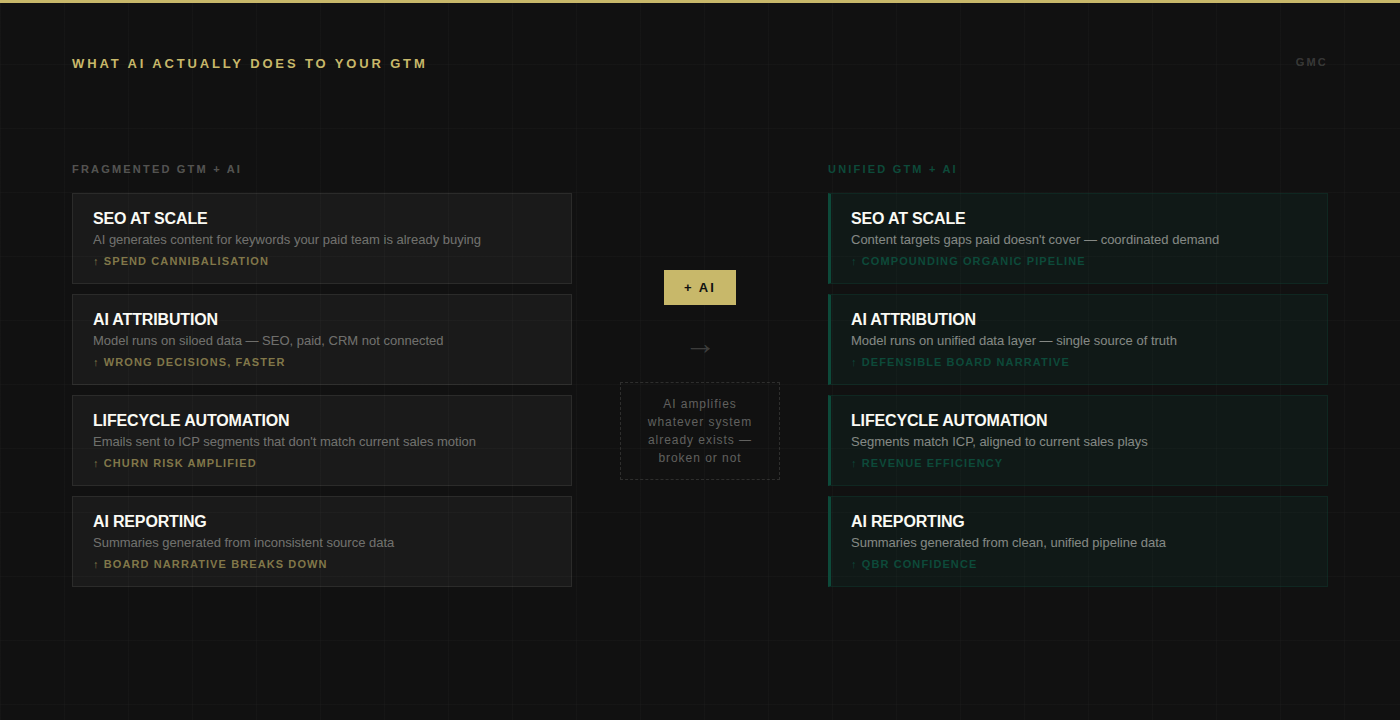
AI doesn't fix broken systems. It accelerates them.
When you introduce AI content generation into a GTM where SEO and paid media aren't aligned on keyword strategy, you get content at scale that cannibalises your own paid spend. When you introduce AI attribution modeling into a stack where CRM, paid, and organic data live in separate silos, you get confident-looking outputs built on unreliable inputs. When you automate lifecycle sequences before your ICP definition is validated against closed-won data, you send more emails to the wrong people, faster.
This is the pattern that plays out in most fragmented GTM environments when AI is introduced too early. Every capability AI brings — speed, scale, automation, synthesis — works in service of whatever system is already there.
If that system is clean, unified, and well-architected, AI creates genuine leverage. If it's fragmented, siloed, and operating without a shared source of truth, AI makes the fragmentation harder to see and more expensive to maintain.
Why Fragmented GTMs Look Fine Until They Don't
One of the reasons this problem persists is that a fragmented GTM rarely announces itself clearly. Each channel reports green. ROAS looks efficient. Organic traffic is growing. MQLs are hitting target.
And then PE sponsors ask a single question — "what actually drove pipeline this quarter, net new, no assisted touches" — and the room goes quiet.
The fragmentation isn't visible in channel metrics. It's visible in the gaps between them. The SEO team and the paid team don't share data. The lifecycle sequences aren't aligned to the current sales ICP. The attribution model credits the last touch, not the incremental one. The six dashboards tell six different stories.
Adding AI into this environment doesn't reveal those gaps. It buries them under a faster-moving layer of output that still can't answer the question PE sponsors are asking.
The Right Order of Operations
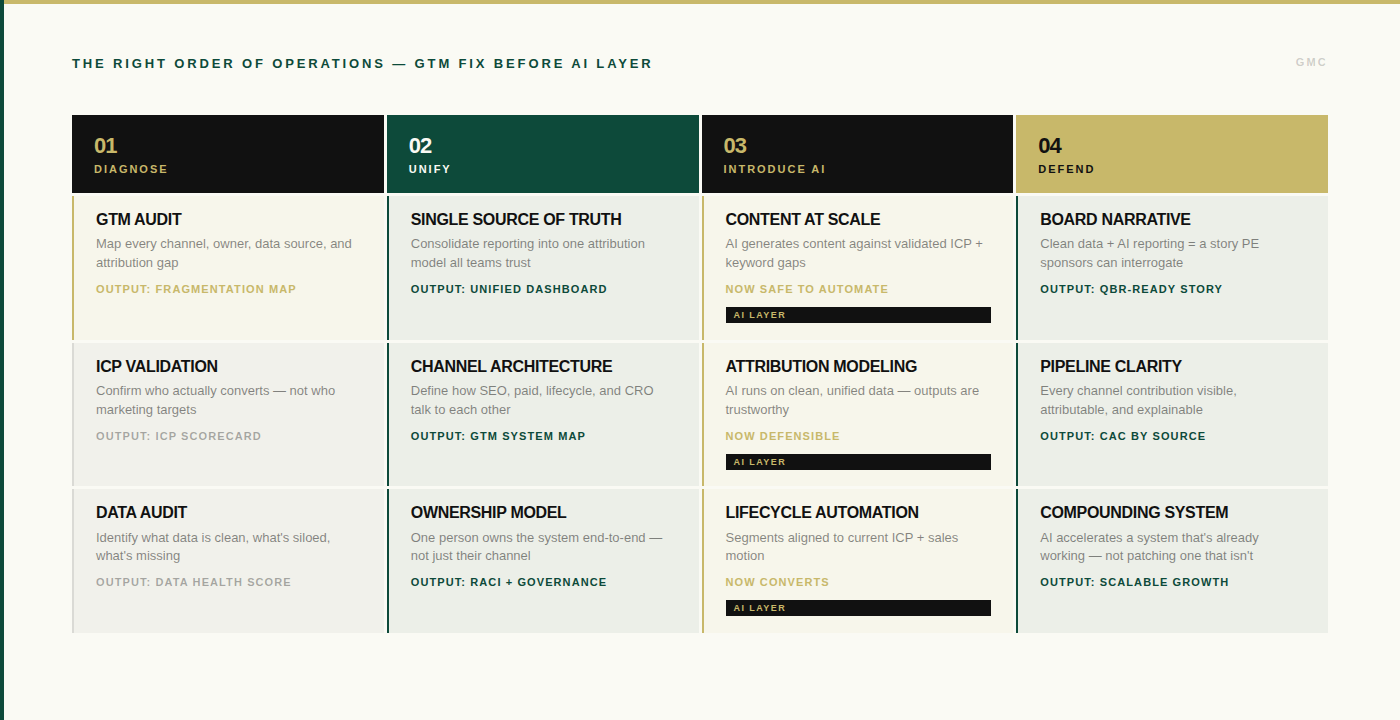
Fixing this requires a sequence, not a tool purchase. Before any AI layer is introduced, three things need to be in place.
First: diagnose the system. Map every channel, every owner, every data source, and every attribution gap. Understand where SEO, paid, lifecycle, and CRO are operating independently — which in most companies is everywhere. Validate the ICP against closed-won data, not assumptions. Score the health of your data infrastructure. This step alone typically surfaces the reason growth stalled.
Second: unify the architecture. Build one source of truth before you automate anything. That means a single attribution model every team trusts, a channel architecture that defines how functions share data and strategy, and a clear ownership model — one person accountable for the system end-to-end, not just their layer of it. This is the hardest step because it requires cross-functional governance, not just technology. It also produces the most durable results.
Third: then introduce AI. With a clean, unified foundation, every AI capability works as intended. Content generation targets gaps that paid doesn't cover. Attribution modeling runs on reliable data and produces outputs you can defend in a QBR. Lifecycle automation sends the right message to the right segment because the segment definition is validated. Reporting summarises a clean data layer, not a fragmented one.
What This Means for PE-Backed CMOs
The pressure to adopt AI in PE-backed environments is real. Operating partners are asking about it. Competitors are talking about it. Board decks reference it. The instinct is to move fast and show initiative.
The CMOs who navigate this well aren't the ones who move fastest on AI adoption. They're the ones who build the foundation first and introduce AI as an accelerant, not a fix.
The sequence matters because the stakes are high. In PE-backed companies, the cost of a wrong bet isn't just wasted budget — it's the credibility question in the next QBR when the board asks what the AI investment produced and the answer is "we're still working through it."
The right answer to that question isn't built in the quarter you're in. It's built by doing the diagnosis and unification work before you automate anything.
Fix the system. Then accelerate it.
The Diagnostic Questions Worth Asking Now
Before investing in any AI marketing tool, these questions produce useful clarity:
Do our SEO and paid teams share keyword strategy and conversion data? If not, AI content generation will create cannibalisation, not compound growth.
Do we have one attribution model that all teams trust? If not, AI attribution will produce confident-looking outputs from unreliable inputs.
Is our ICP validated against closed-won data from the last 12 months? If not, AI-powered personalisation will target the wrong people at scale.
Can we explain what drove pipeline last quarter without pulling six dashboards? If not, no AI reporting tool will produce the board narrative you need.
If the answer to any of these is no, the next investment isn't AI. It's the architecture that makes AI work.
Growth Marketing Consultancy builds unified GTM systems for PE-backed and founder-led mid-market companies. If your growth is stalled and AI feels like the answer, we should talk about what comes first.